Rainmaking Mushrooms
Don’t like the weather...blame it on the mushrooms!?

A wonderful afternoon at the London Natural History Museum here in London…and looking forward to tomorrow’s trip from here to Paris and then Paris to Bordeaux…via my favourite mode of transit: train. I like trains!
But there’s still awesome science to share…There’s a new paper that suggests our mycelium friends may be influencing our weather!
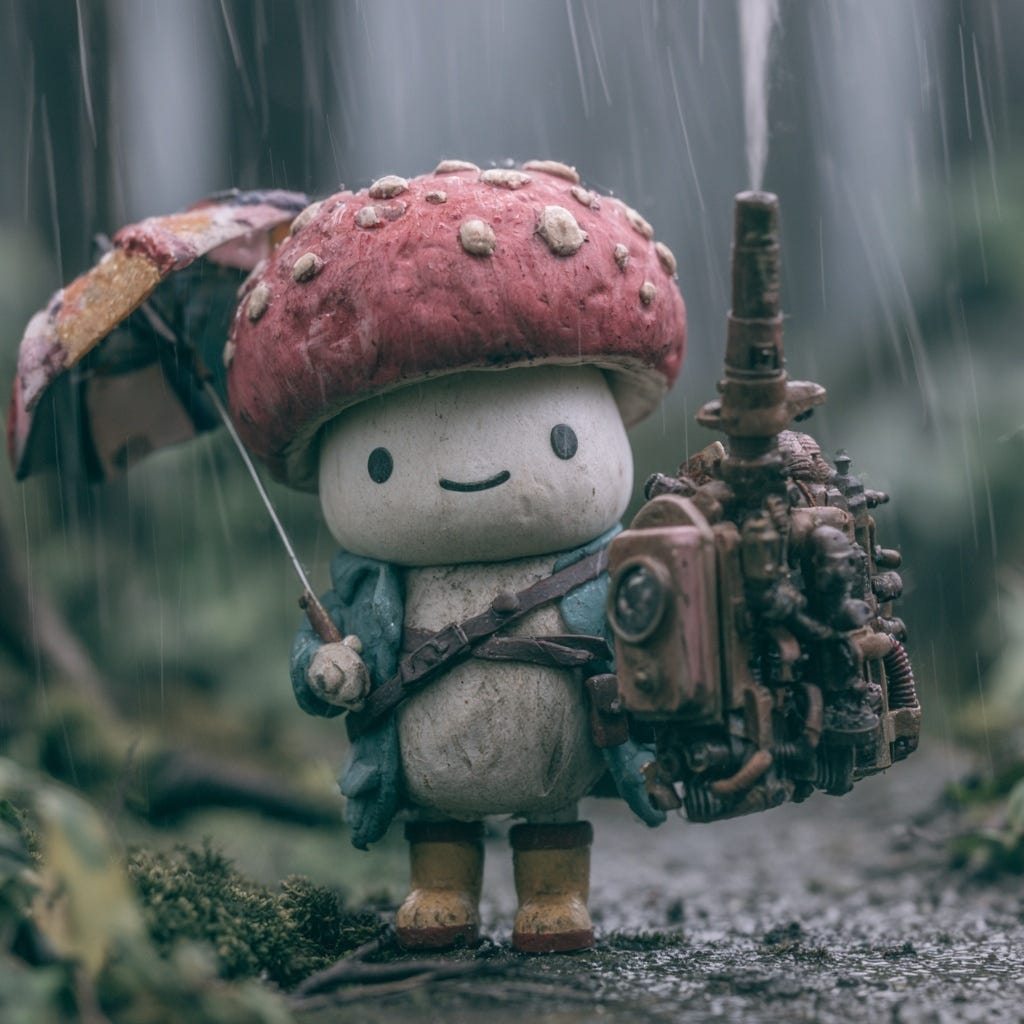
‘Shroom Nerds recently discovered that fungi produce highly effective ice-nucleating proteins, that can force water to crystallize at much warmer temperatures than it would on its own.
High up in the atmosphere, water can stay liquid even when it is freezing cold. But in order to become rain or snow, this super-cooled water needs a “seed” (like dust, soot or sea salt) to grab onto and freeze. Water seeded with dust normally needs extremely cold temperatures to actually freeze.
Well, our Fungi friends secrete special ice nucleating proteins that end up in the surrounding soil. These proteins are tiny, tough, and water-soluble, making it easy for them to get swept up high into the clouds where they’re super-efficient, ice-encouraging rain seeds. And it turns out that fungi didn’t even evolve their own ice-nucleating proteins, they “stole” the ability from bacteria using something called “Horizontal Gene Transfer”. And here I go, down a whole molecular biology wormhole of copy and pasting genes...skip a few paragraphs down if you want to just stick with the fungi rain!
This rare bacteria to fungi evolutionary heist can happen in a few different ways:
In Transformation...A bacterium dies and spills its DNA guts into the surrounding environment. That DNA breaks up into fragments and floats around. Nearby, still living, bacterium have special proteins on their surface called competence factors(like little scoops). When conditions are right (stress, starvation or overcrowding)...so I guess it would be better to say, when conditions are wrong…these competence factor bacterium activate their “scoops” and start taking in nearby DNA fragments. If the foreign DNA is compatible, it gets threaded into the cell where the cell’s own repair machinery stitches it into its own chromosome. Not all bacteria can do this, only those that are in a state of competence can pull it off. Another cool part of this is that franken-cell-scientists can “force” bacteria into competence using heat shock or electrical pulses...a key component in genetic engineering!
The second way is transduction. This one involves bacteriophages (the playground for my friend Professor James R. Gurney…and another fabulous I’m With (Stargate) Genius guest).
Viruses that infect bacteria are called phages (“bacteria eaters”). In Transduction a bacteriophage lands on a bacterium and injects its DNA into the helpless victim, hijacking the bacterium’s machinery so that it makes thousands of copies of itself. Here comes the horizontal gene transfer...sometimes when those new virus particles are being packaged up, the packaging machinery makes a mistake and grabs a chunk of the bacterium’s DNA instead of just the viral DNA. So when the virus bursts out of the cell (always makes me think of that lovely Alien breakfast, chest-burster scene) that virus is now carrying bacterial genes as well. When that virus goes on to infect the next bacterium it copies those extra bacterial genes too. This is how the bacteria that cause scarlet fever got their toxin-producing genes. A phage delivered them from another species entirely...yikes!
The last way is, Conjugation, what I think is the coolest method... bacteria whack up against each other and directly pass DNA between them! Some bacteria carry a special extra loop of DNA called a plasmid, which is like a little USB drive compared to the hard drive of the chromosome. Plasmids often carry “bonus” genes like antibiotic resistance or toxin production. One of these bacteria, carrying a plasmid, grows a long protein tube called a pilus…it’s like a tiny biological pirate’s grappling hook. The pilus reaches out, grabs a nearby bacterium, and reels it in until the two cells are touching. A channel, called a conjugation bridge, forms and the plasmid is copied and passed to the captured bacterium...so the donor keeps its plasmid too. This is pretty wild, especially since it can happen between different species entirely. One bacterium can conjugate (look at me casually using “bacterial conjugation” in a sentence!) with multiple bacterium in a short time and they can carry multiple resistance genes at once, so one transfer can carry multiple resistance genes at once, to several antibiotics...which is pretty worrying now I think about it?! And some of those plasmids can carry genes that make the recipient better at conjugating, so resistance can cascade through a population really quickly...yay molecular biology? I really want to get James Gurney back for another molecular biology phage chat more than ever now!
Okay...wormhole escaped... for the moment!
Scientists think fungi use their ice-nucleating protein production abilities ( acquired by horizontal gene transfer from bacteria) to protect their delicate mycellium cells from dangerous flash-freezing. Freezing at higher temperatures slows the process and avoids the dreaded “cell shredders”...jagged ice formations that literally tear the cell to pieces. There’s also the problem that while freezing, the remaining liquid has a higher salt concentration than the fluid inside the cell, and this osmotic imbalance can violently draw the water out of the cell, turning it into a shriveled raisin. I you want to really get nerdy about ice, then Reactions has a really interesting video on it…the “fractal forest” is my fave!
The fungi-infused freeze is much gentler and results in rounder ice formations. This gives the cell time to adapt to the salt concentration imbalance and produces less jagged ice crystals to cause damage to cell membranes, proteins and internal structure.
But these same freeze-inducing proteins, get secreted by the fungi and end up in the surrounding soil. Since they are water-soluble, really tough and are easily swept up by wind, they end up in the clouds. And the brilliance doesn’t stop at the molecular level. These fungal proteins are made up of repeating amino acid motifs (motifs were new to me...they’re basically lazy biology, reusing particularly useful sequences of amino acids). This particular combination is particularly good at binding (”parking” in the water rather than just drifting away) and organizing water molecules. The proteins assemble into a broad, flat structural, scaffold that forces supercooled water to align and crystallize into ice at relatively warm...but still subzero...temperatures.
These fungal ice crystals grow in the clouds until they become heavy enough to fall back to the earth as rain that hydrates the soil and allows the fungi and surrounding plant life to thrive. I’ve always assumed that fungi like dark, wet spaces...I love the idea that they might be creating their own ideal environment! Of course, then we butt into the whole cycle, cutting down forests and potentially destroying the biological engine that creates local rainfall. But what if we could make use of these fungal rainmakers to seed clouds with cheap, organic, non-toxic ice-nucleating particles?
Make it rain, mushrooms!
If you’re enjoying these emails of Awesome Awesomeness then why not chat with like-minded CaNERDians, over at CaNERDia, our friendly free and fantastic discord chat!
And of course, Patreon support is always appreciated too!
En attendant de refaire nos geeks…
Soyez courageux…
Soyez Gentil…
Soyez BRILLIANT!
Cheerio et Huzzah!

Lovely article about how fungi can influence rainfall! I’ve always been a fungi fan (ex‑microbiology student, beginner forager, mushroom cultivator and nature macrophotographer here 👋 ) and this is going straight onto my list of ‘reasons why fungi are AWESOME’ 💪 It was also such a fun way to help my little biologist brain grasp some physics 🌱 As an current anthropology student focused on planetary health, it sent me down a rabbit hole about aerosol–cloud interactions and how pollution affects rainfall and creates inequalities in water distribution …!it was very cool to see these threads connect ! 🤓
Loved reading this & getting to know the science behind mushroom rainfall! I’d heard a couple years ago that mushrooms make rain. I’d also heard when I was a child that my ancestors, who came from Tibet, were rainmakers. They were summoned a few hundred years ago by the king of Nepal to come & end a drought. They must’ve done a good job because my ancestors stayed in Nepal till this day. When I first found out that mushrooms make rain, I wondered if my Tibetan ancestors had caught on to how powerful mushrooms are. Maybe they had learned to cultivate them, and thus ended a drought through that knowledge 🤗🍄🟫